
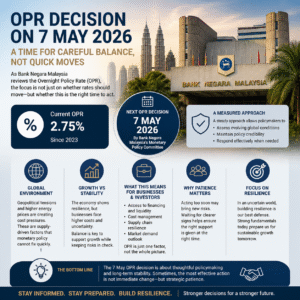
As Bank Negara Malaysia approaches its upcoming decision on the Overnight Policy Rate (OPR) on 7 May 2026, the focus is not just on whether rates should move—but whether this is the right time to act.
At present, the OPR stands at 2.75%, following earlier adjustments aimed at supporting economic recovery. While there have been growing discussions around a potential rate cut, the broader economic environment suggests that a measured and cautious approach may be more appropriate.
🌍 Understanding the Current Environment
Recent global developments, particularly geopolitical tensions and elevated energy prices, are contributing to cost pressures across industries. These are largely supply-driven factors, which tend to behave differently from demand-led economic slowdowns.
In such conditions, monetary policy tools like interest rate adjustments may have limited immediate impact on inflation, especially when price increases are driven externally rather than by domestic demand.
📉 Growth vs Stability: Finding the Right Balance
Malaysia’s economy continues to show resilience, with steady growth and manageable inflation levels. However, businesses are increasingly navigating:
- Higher operating costs
- Margin compression
- Uncertainty in global demand
While a lower interest rate could provide some support, it is also important to ensure that policy decisions do not unintentionally introduce new risks, particularly in a still-uncertain global environment.
💼 What This Means for Businesses and Investors
From a practical perspective, the OPR is just one of many factors influencing business and investment decisions. More critical considerations today include:
- Access to financing and liquidity
- Cost management strategies
- Supply chain resilience
- Market demand outlook
In other words, while interest rates matter, confidence and clarity in the economic outlook often matter more.
🧠 A Thoughtful Approach Moving Forward
The upcoming decision is less about urgency and more about timing and alignment with broader economic realities. A steady approach allows policymakers to:
- Better assess evolving global conditions
- Maintain policy credibility
- Respond more effectively if clearer signs of slowdown emerge
🎯 Final Thoughts
The 7 May OPR decision presents an opportunity for measured, forward-looking policymaking. In today’s environment, sometimes the most effective action is not immediate change—but strategic patience.
For businesses, investors, and financial professionals, this is also a reminder to look beyond interest rates and focus on building resilience in an increasingly complex global landscape.