
Why State-Linked Oil & Gas Companies Need a Dedicated Treasury Department
In today’s energy industry, managing oil and gas assets alone is no longer enough.
Modern energy companies must also manage:
• Financial volatility
• FX and interest rate risks
• Commodity price fluctuations
• Geopolitical uncertainty
• Funding and liquidity challenges
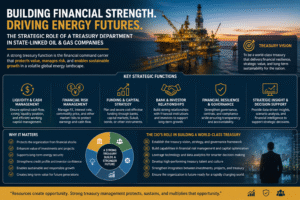
This is why a dedicated Treasury Department is becoming increasingly important for state-linked oil and gas corporations.
Treasury is not just about banking or payments.
It is the financial command center of the organization — responsible for protecting financial stability, strengthening resilience, supporting capital raising, and managing long-term strategic risks.
A strong treasury division helps organizations:
• Improve financial discipline
• Enhance governance and transparency
• Monitor market and liquidity risks
• Strengthen investor and banking confidence
• Prepare for financial and economic crises
As energy projects become larger and more complex, treasury capabilities in areas such as:
• Infrastructure financing
• Sukuk and bond issuance
• Commodity hedging
• ESG-linked financing
• AI-driven financial analytics
will become increasingly critical.
This is where the Chief Investment Officer (CIO) plays an important role.
A forward-looking CIO must not only focus on investments, but also help build the financial architecture and treasury capabilities needed for long-term sustainability and resilience.
Natural resources create opportunity.
Strong treasury management protects and multiplies that opportunity over the long term.
#Treasury #OilAndGas #EnergySector #RiskManagement #CIO #FinancialStrategy #CorporateTreasury #EnergyTransition #Governance #InfrastructureFinance